
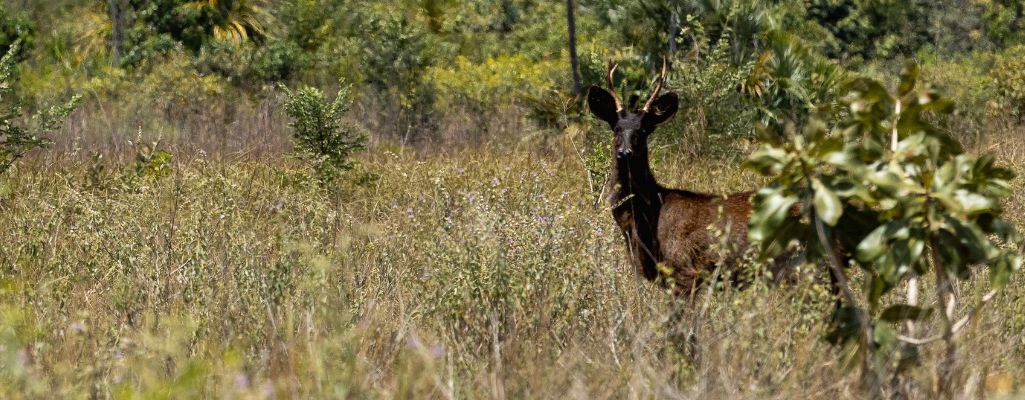
Onçafari, in partnership with Embrapa Pantanal researcher Walfrido Tomas, documented the first records of melanistic marsh deer (Blastocerus dichotomus). The discovery is detailed in the scientific note “First ever records of melanism in Marsh deer Blastocerus dichotomus” published in the journal Notas sobre Mamíferos Sudamericanos.
The records were made in the Pantanal, at Caiman Pantanal, and in the Cerrado, at Grande Sertão Veredas National Park (PNGSV). Although cases of albinism (complete loss of pigmentation) and leucism (partial loss of pigmentation) had been documented in marsh deer, there were no prior scientific records of melanistic individuals of the species.
-
- Credit: Taile Emanuele


The first record occurred in February 2021 when the Onçafari team observed an adult female marsh deer with dark fur at Caiman Pantanal.
The biome is home to approximately 88% of Brazil’s marsh deer population, estimated at around 40,000 individuals. Even so, after 40 years of research and surveys of the species in the region, no melanistic individual had been officially documented in the scientific literature. Following this observation, this particular animal was never seen again in the area.
Although there were no scientific records, local pantaneiros had previously reported sightings of dark-colored marsh deer in the region. One example is in Baía do Cervo Preto, a place whose name refers to the possible presence of these animals.
Melanism: a rare trait
Melanism is a pigmentation abnormality characterized by an excess of melanin resulting in darker coloration of the fur. Pigmentation anomalies are considered rare among mammals, occurring in approximately 13% of species, and have been documented in several deer species.

Credit: Edu Fragoso
Since 2022, the Onçafari team has conducted intensive camera-trap monitoring in Grande Sertão Veredas National Park. Of the 61,830 camera-trap videos recorded, only 31 records involved marsh deer, locally known as suçuaparas in this region of the Cerrado. Of these, three were melanistic individuals.
In addition to camera-trap records, 12 direct sightings of marsh deer were recorded in the park, eight of which involved melanistic individuals. Overall, including both the Pantanal and Cerrado, 12 sightings of melanistic marsh deer were recorded: one at Caiman Pantanal and 13 at Grande Sertão Veredas National Park.
In the Cerrado, melanistic individuals accounted for 66.7% of the direct sightings of the species made by the team during the study period. After the submission of the scientific note, additional direct observations of the species were made, including the sighting of a very young male with dark fur.
The frequency of melanistic marsh deer sightings in the Cerrado
The species faces habitat loss and fragmentation, the reduction of wetlands, and increasing human pressure. These factors limit animal movement and reduce connectivity between different populations.
In small and isolated populations, processes such as genetic drift, isolation, and inbreeding can have a significant influence on genetic composition. Onçafari hypothesizes that these factors may be favoring melanism in the Cerrado population.
“These records in the Cerrado serve as a warning for the conservation of the species in the biome as this mutation may indicate that the population’s genetic health is at risk. We believe these animals are highly confined within the boundaries of Grande Sertão Veredas National Park because the surrounding areas are already highly degraded and face even greater hunting pressure. This results in population isolation and, very possibly, a higher frequency of melanistic individuals,” says Edu Fragoso, Coordinator of Onçafari’s base at Grande Sertão Veredas National Park and co-author of the study.
This hypothesis still needs to be investigated. The records do not allow us to conclude that isolation is responsible for melanism, but they indicate a possible relationship.

Credit: Taile Emanuele
For this reason, long-term monitoring is essential not only to document previously unknown characteristics, but also to identify ecological and genetic patterns and changes over time.
Each record helps expand our knowledge of the species and can provide important information for understanding the challenges it faces across different landscapes in Brazil.