According to the World Meteorological Organization (WMO), the 2026 El Niño is expected to be strong and highly intense, prompting Onçafari to raise concerns about the increased risk of wildfires, heatwaves, and extreme drought, all of which threaten Brazil’s wildlife and ecosystems. Although El Niño is part of the Earth’s natural climate cycle, scientists warn that its impacts are becoming increasingly severe due to human-induced global warming.
Characterized by a warming of the sea surface temperatures in the equatorial Pacific Ocean (Regions 3 and 4) by 0.5°C or more above average for several consecutive months, El Niño alters global climate dynamics. This phenomenon changes atmospheric circulation patterns, affecting wind systems and cloud formation, while redistributing heat and moisture throughout the atmosphere. As a result, it causes significant changes in rainfall and temperature patterns across multiple continents.

Caption: Formation of El Niño in Regions 3 and 4 of the Pacific Ocean, shown as the darker area on the map. Credits: Reproduction of MetSul Meteorologia.
The phenomenon begins developing during the first half of the year, becomes established between winter and spring in the Southern Hemisphere, and produces its greatest impacts from the end of the year through the first months of the following year. El Niño events typically occur every two to seven years, varying in intensity and duration. Over the past decade, however, scientists have warned that climate change has made these events more frequent and more intense.
The Impacts of El Niño
Although El Niño is a naturally occurring climate process, it now unfolds on a planet whose average temperature has already risen by approximately 1.3°C compared to the pre-industrial period according to the Intergovernmental Panel on Climate Change (IPCC). As a result, global warming acts as an amplifying factor. El Niño itself remains a natural phenomenon, but its impacts tend to be intensified in a warmer atmosphere.
While southern Brazil is expected to experience above-average rainfall, increasing the risk of flooding and landslides, parts of the Midwest, North, and Northeast are likely to face reduced rainfall, prolonged droughts, and higher temperatures.
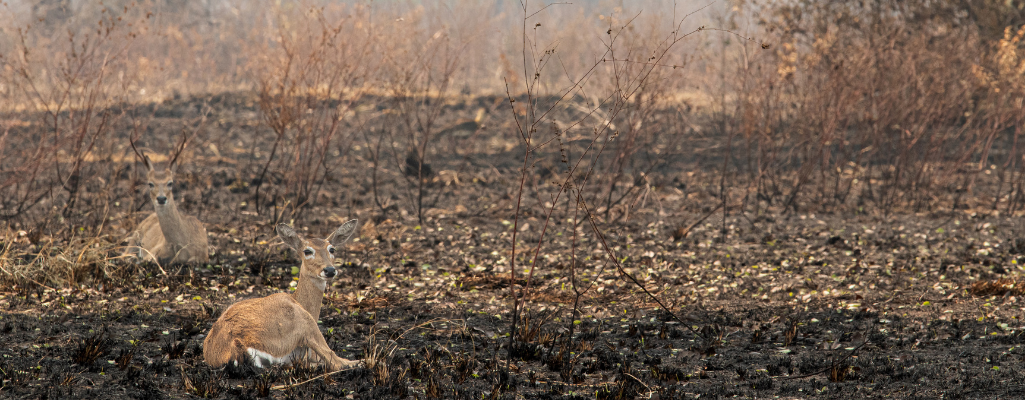
These extreme events, combined with deforestation, habitat fragmentation, and the loss of native vegetation, reduce forests’ ability to regulate the climate. As ecosystems become drier and retain less moisture, they become increasingly vulnerable to both the occurrence and spread of wildfires.

Credit: Edu Fragoso
In response to these challenges, since 2020, Onçafari through its Forests Initiative has expanded its work to establish and strengthen ecological corridors by acquiring strategically located protected areas that are essential for conservation. These reserves help maintain connected landscapes, enable wildlife movement, preserve genetic flow between populations, and support healthy ecosystem functioning. Today, the organization owns eleven reserves across the Amazon, Pantanal, and Atlantic Forest protecting more than 125,000 hectares.
This same vision also guides the Jaguar Rivers Initiative (JRI), an international partnership developed with Rewilding Argentina, Nativa (Bolivia), and Fundación Moisés Bertoni (Paraguay). The initiative seeks to create a continental ecological corridor along the Paraná River Basin connecting approximately 2.5 million km² through large protected areas, integrated landscapes, ecological stepping stones, and natural corridors formed by the river systems themselves.
Onçafari’s Fire Prevention
Regardless of climate phenomena such as El Niño, Onçafari operates under the same guiding principle; in an era of climate change, every wildfire is an extreme wildfire.
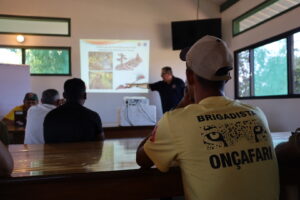
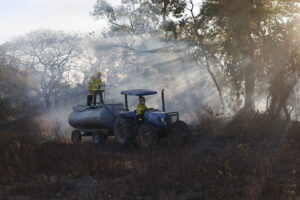
For this reason, Fire Prevention is planned and strengthened every year through robust measures designed to reduce risks, improve emergency response capacity, and prepare teams for both prevention and firefighting.
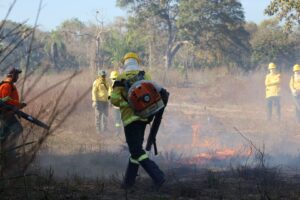
In 2026, given the forecast of El Niño conditions, many of these measures were implemented earlier than in previous years. Whereas operational plans, training, and equipment procurement were typically completed by mid-year, in 2026 the preparation phase concluded in April, allowing reserves to begin preventive actions such as firebreak maintenance well in advance.
-
- Credit: Julia Santos

-
- Credit: Julia Santos

-
- Credit: Julia Santos

Each of Onçafari’s private reserves has its own Wildfire Prevention, Preparedness, and Response Plan (PPCIF) developed as an operational document to support rapid consultation and decision-making during emergencies. These plans compile strategic information on personnel, equipment, logistics, command structure, and response protocols, while also defining the actions planned for each reserve. Across all reserves, the 2026 operational plans include the maintenance of 353 km of firebreaks, construction of an additional 41.8 km of new firebreaks, three Incident Command System (ICS) training courses, firefighter training programs, and the hiring of six new wildland firefighters.
The 2024 Wildfires
In 2024, the Pantanal experienced one of the most severe wildfire seasons ever recorded. The crisis resulted from the combination of several factors, including the accumulation of organic fuel loads associated with the 2023–2024 El Niño, human activity, and extreme weather conditions such as prolonged drought, high temperatures, and very low humidity. Together, these conditions created an environment in which fire spread rapidly across the biome.
The catastrophic 2024 wildfires burned between 1.9 and 2.6 million hectares in the Pantanal, equivalent to approximately 15% to 17% of the entire biome, according to data from LASA/UFRJ. Within Onçafari’s areas of operation, an average of 105,000 hectares burned across eight of the organization’s operational bases.

Credit: Mario Nelson
Today, Onçafari’s focus is not only on responding to wildfires but, above all, on preventing them through proactive management and stronger partnerships with local communities.
“The 2024 wildfires left deep scars, including the loss of Gaia, one of the first jaguars monitored by our organization. Although the experience was extremely challenging, it taught us valuable lessons that have made us far better prepared and more responsive in addressing wildfires. Today, Onçafari is the first civil society organization in Brazil to have a licensed Integrated Fire Management Plan for a private property and we have developed a highly robust rapid-response protocol for dealing with simultaneous wildfire events.”
– Ananda Andrade, Onçafari Fire Prevention Management Coordinator