
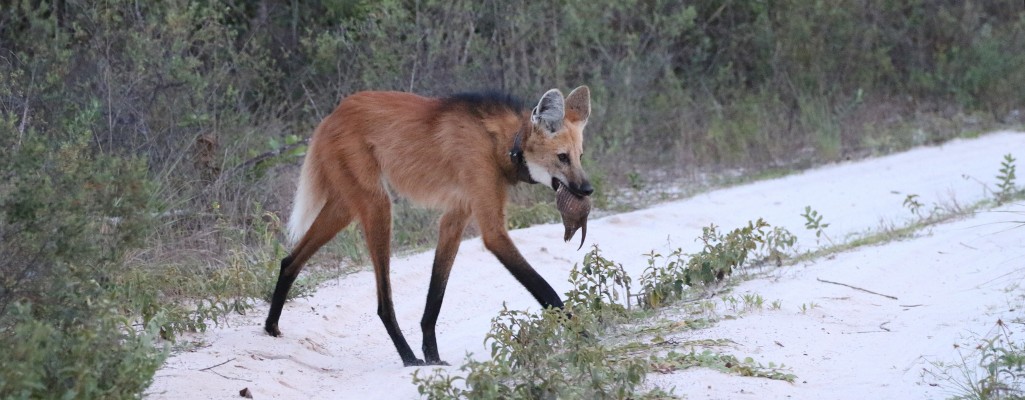
In the region of Pousada Trijunção in the Brazilian Cerrado, Onçafari monitors biodiversity with an emphasis on maned wolves as part of an ongoing effort in conservation monitoring and ecotourism. Among them is Savana, a female monitored since 2022, whose records help researchers understand and study the species’ behavior within this landscape.

Image credits: Barbara Dias
During a family’s stay at Pousada Trijunção, an interesting coincidence caught everyone’s attention; the family’s daughter was named Savana. In the field, this shared name ended up accompanying an equally special moment of observing the wolf.
At that time, marked by the rainy season, the wolves were more elusive, remaining for long periods in areas of denser vegetation where food availability was high. This reduced their use of roads, which are typically used to facilitate sightings.
Telemetry monitoring indicated constant movement by Savana with zigzag patterns that required about two hours of tracking before the first sighting. The sighting was brief, but enough to highlight the female’s active behavior within that territory.
The following day another field outing brought a new opportunity. Despite unfavorable conditions for direct observation, the signal indicated that Savana was moving near the lodge area. After moving through denser vegetation, she crossed a road briefly before disappearing again into the landscape.
Minutes later the wolf reappeared carrying prey. With the support of a drone, it was possible to record feeding behavior in detail. She was eating a soft-tailed armadillo. The female spent about 20 minutes handling and feeding on part of the prey.

Image credits: Paulo Dias
After this period the team repositioned the safari vehicle and again recorded the wolf crossing the road with part of the prey. She then vocalized in an area where there had been previous records of interaction with pups, suggesting possible communication, although it was not possible to confirm the presence of young at that moment.
The outcome of this sequence was not recorded. Even so, the episode reinforces the complexity of the species’ behavior and the importance of continuous monitoring to understand its strategies for feeding, movement, and parental care.
More than definitive answers, fieldwork often reveals fragments of stories. It is through this process between records, tracking, and observation that knowledge about the Cerrado’s wildlife is built.
Want to read more about the predation habits of maned wolves, especially involving larger species? Check out the article here.
Text by: Maria Julia Sternberg and the Trijunção team