
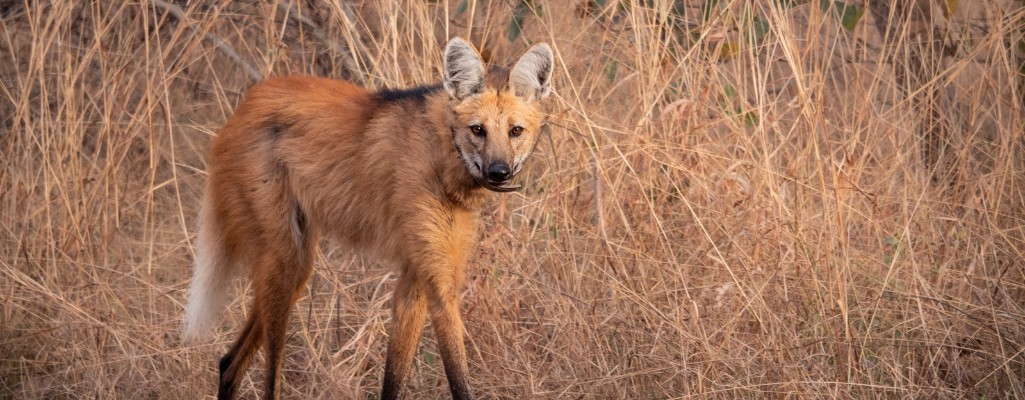
The maned wolf (Chrysocyon brachyurus), the largest canid in South America, is one of the Cerrado’s most iconic animals. With its long legs, reddish coat and distinctive dark mane extending along the back of its neck, it is a remarkable species. On Maned Wolf Day, celebrated on October 12, we take the opportunity to learn more about this species and what we can discover by following its life closely.
Despite its name, the maned wolf is not a true wolf. It is a unique species with no close relatives among living canids, and its characteristics reflect its adaptation to the environments it inhabits. Its diet is highly varied, including fruits such as the wolf apple, as well as small vertebrates, arthropods and, occasionally, larger prey.
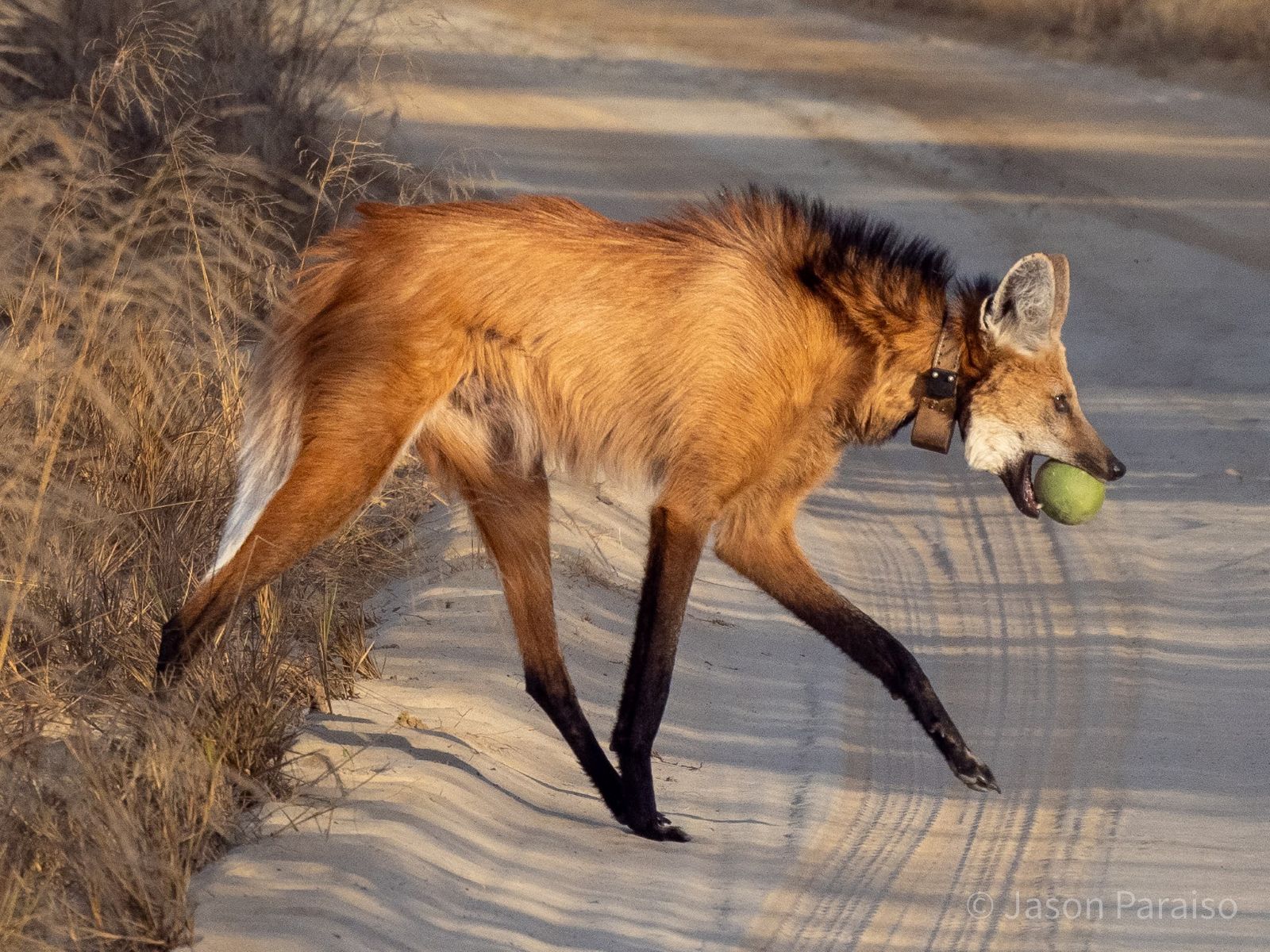
Maned wolves are generally solitary animals and are rarely observed walking or hunting together. However, once a pair forms, the two individuals share the same territory. Parental care is also shared. Both the female and the male participate in raising the litter during the pups’ first year of life.
Onçafari’s Maned Wolf Monitoring in the Cerrado
In 2018, Onçafari began its work in the Cerrado at Pousada Trijunção, an area spanning more than 33,000 hectares on the border of the Brazilian states of Minas Gerais, Bahia and Goiás. The work focuses on monitoring maned wolves through initiatives involving ecotourism, science, education, social programs and reintroduction.
Through ecotourism, the work combines animal monitoring with environmental education, allowing visitors to observe maned wolves in the wild without altering their behavior. This is made possible by a habituation process that helps the animals become accustomed to the presence of field vehicles. At the same time, the team monitors their movements, behavior, health and interactions with their environment through field observations, camera traps and, for some individuals, GPS and VHF collars.
The first tracking collar fitted to a maned wolf at Pousada Trijunção was placed on Diadorim in December 2018. Since then, eight years of continuous monitoring have allowed the team to follow 18 individuals, uncovering more about this species and the Cerrado.
From Den to Den: Following New Generations
Over the years, Onçafari has monitored several female maned wolves during their reproductive periods at Trijunção. This work makes it possible to observe stages of their lives that would be difficult to witness through direct encounters alone, including the first months of development, their relationships with their parents and the process of becoming independent.
Some of these stories continue from one generation to the next, as in the case of Savana. She was born in Nhorinhá’s 2021 litter. Nhorinhá was monitored by Onçafari for five years, until her death. After her mother died, Savana returned to the area around Pousada Trijunção, where she began occupying her mother’s former territory. As an adult, she formed a pair with Barão, and the two have since begun a new reproductive story followed by the team.
In June 2023, Savana and Barão had their first litter recorded by Onçafari. The following year, the pair had another litter. Since then, they have continued to share the territory, while the team monitors their litters. In total, the pair has had four recorded litters.
Each new litter offers an opportunity to closely follow a different stage in the lives of maned wolves. The pups begin exploring the area around the den, start accompanying their parents on their movements and gradually develop the skills needed to live independently. These observations provide valuable information for the team monitoring them.
Every Record, New Discoveries
Although the maned wolf has a varied diet based mainly on fruits and small animals, some records indicate that it also consumes larger prey. However, little is still known about how these prey animals are hunted, as there are few scientific records documenting the pursuit and predation of large animals by maned wolves.
During Onçafari’s monitoring work in 2022, Buriti surprised the field team when he was observed preying on an adult greater rhea. The male had been monitored since 2021 and, at the time, was paired with Nhorinhá.
This observation led to the scientific note First record of a maned wolf preying on greater rhea, published in 2026. The study presents the first documented record of a maned wolf preying on an adult greater rhea, expanding our understanding of the species’ behavior.
Following in her father’s footsteps, Savana also began pursuing and preying on animals that are uncommon in the maned wolf’s diet. Since the birth of her first litter in 2023, the female has been observed preying on pampas deer fawns on two consecutive days and, on other occasions, carrying parts of deer carcasses.
What Long-Term Monitoring Can Reveal
Following a species over several years allows researchers to go beyond isolated records and build a more complete picture of its life. It becomes possible to identify individuals, track their growth and movements, observe behavioral changes, identify relationships between animals and follow different generations over time.
This continuous observation turns each sighting into part of a larger story. A den discovered, a growing pup, an unexpected behavior or an encounter at an unusual time of year can all provide new information about the species. Over the years, these findings expand the knowledge needed to understand and conserve the maned wolf and the Cerrado.