
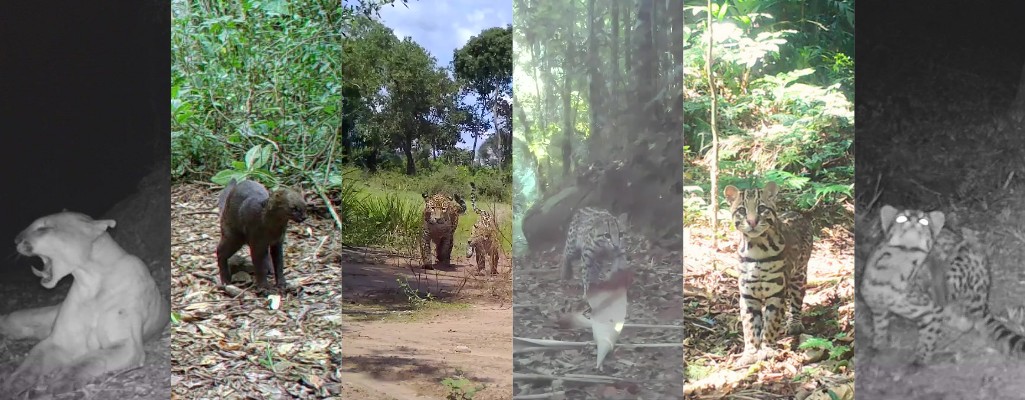
Onçafari is taking part in the “Where Do Wild Cats Roam?” initiative, a project promoted by the Biodiversity Observatory, an initiative of Instituto humanize. The project aims to expand access to information on records of wild cats in Brazil by bringing together data that are often dispersed, restricted, or difficult to access.
The first Onçafari datasets published on the Brazilian Biodiversity Information System (SiBBr) bring together wildlife monitoring records from two areas where Onçafari operates. This is the first step toward making scientific knowledge about Brazilian biodiversity more open, expanding access to the data that Onçafari collects in the field.
“For Onçafari, the “Where Do Wild Cats Roam?” project was the ideal opportunity to join a global initiative focused on making scientific data publicly available. Publishing our first dataset on SiBBr puts us on the radar of other institutions that may want and be able to use this data for scientific and conservation purposes.”
– Marcella Pônzio, Scientific Coordinator at Onçafari
SiBBr works as a large public repository of Brazil’s biodiversity, coordinated by the Ministry of Science, Technology and Innovation (MCTI), with technical support from the United Nations Environment Programme (UNEP). It is the Brazilian branch of GBIF (Global Biodiversity Information Facility), a network that connects biodiversity data from around 60 countries and brings together information from Brazilian institutions such as universities, museums, botanical gardens, public agencies, and NGOs. Therefore, data published on the platform do not remain isolated within Onçafari or in Brazil: they also become available to researchers working outside the country.
What is open science and why does it matter for conservation?
Over the years, conservation organizations accumulate a large volume of information through fieldwork on wild cats, including locations, behaviors, camera trap records, GPS collar data, and more. However, much of this information is never systematically organized and made openly available, limiting its potential use.
Open biodiversity science is a way of multiplying the value of data. A published record can be used by other researchers to understand the distribution of a species, plan a protected area, or conduct academic research.
“Openly publishing research data means that it no longer benefits only a single project, but becomes part of a collective body of knowledge, providing evidence for conservation decisions and public policies.”
– Marcos Brito, Scientific Analyst at Onçafari
Two biomes, two public datasets
This work resulted in the publication of two Onçafari datasets on SiBBr: one containing wildlife monitoring records from Itatiaia National Park in the Atlantic Forest, and one from the Caiman Pantanal region.
Although both were produced through fieldwork, the datasets are different. In Itatiaia, the published data include a list of the 28 species of medium and large-sized terrestrial mammals recorded during monitoring. Among them are five wild cat species: jaguarundi (Herpailurus yagouaroundi), southern tigrina (Leopardus guttulus), ocelot (Leopardus pardalis), margay (Leopardus wiedii), and puma (Puma concolor). At Caiman, the dataset contains 2,012 wild cat records distributed across four species: jaguarundi, ocelot, jaguar (Panthera onca), and puma.
Onçafari’s goal is to make this information available to the scientific community, allowing other researchers to cross-reference these data with different sources of information and develop new analyses and questions about wild cats and Brazilian biodiversity.
Initiatives like this reinforce Onçafari’s commitment to bringing together field conservation, science, and transparency. By making data on where and how Brazilian wild cats live publicly available, Onçafari contributes not only to academic research, but also to conservation policies.
The data from Itatiaia National Park and Caiman Pantanal are already available on SiBBr, together with the other materials from the “Where Do Wild Cats Roam?” project. To access them, click here.