
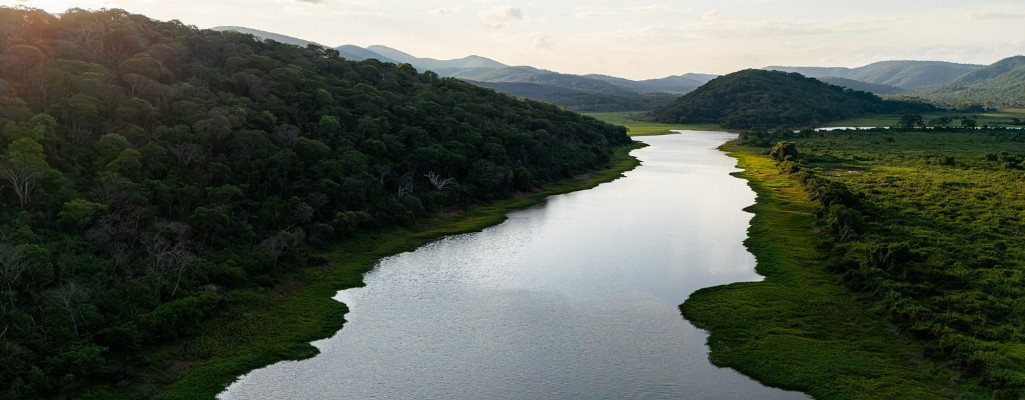
Conserving biodiversity requires strategic action. Increasingly, protecting natural areas alone is not enough. It is also essential to create pathways that connect them.
In recent years, Onçafari has expanded its conservation footprint through the acquisition and management of strategically important areas for biodiversity. Today, more than 125,000 hectares are protected across privately owned reserves located in different Brazilian biomes. These areas serve as key strongholds for wildlife and native ecosystems.
While these reserves play a critical role in protecting fauna and flora, they do not function in isolation. They are part of a broader ecological connectivity strategy designed to maintain functional landscapes. This approach allows wildlife to move freely, reproduce, and contribute to the long-term balance of ecosystems.
Habitat Fragmentation: One of Brazil’s Greatest Environmental Challenges
Despite being home to one of the richest biodiversities on Earth, Brazil has experienced significant losses of natural habitat. According to MapBiomas, the country lost approximately 111.7 million hectares of native vegetation between 1985 and 2023. This represents roughly 13% of the country’s territory.
Habitat fragmentation reduces the continuity of natural landscapes and directly affects wildlife movement, ecosystem functioning, and nature’s ability to regenerate.
The Role of Protected Areas in Biodiversity Conservation
Protected Areas are the foundation of Brazil’s National System of Conservation Units (SNUC) and represent the country’s primary framework for biodiversity conservation.
Today, Brazil is home to more than 3,000 Protected Areas, including national parks, biological reserves, ecological stations, and other categories of protected and sustainably managed lands. These areas safeguard ecosystems and species while supporting essential ecosystem services such as climate regulation, water security, and biodiversity conservation.
Despite their importance, many Protected Areas function as isolated islands within increasingly modified landscapes. This isolation restricts wildlife movement and gradually weakens ecological processes.
Ecological Corridors: Connecting to Conserve
In response to this challenge, ecological corridors have emerged as an increasingly important conservation strategy.
The Jaguar Rivers Initiative (JRI) is an international effort focused on establishing ecological corridors throughout the Paraná River Basin. The initiative connects natural areas across Brazil, Argentina, Bolivia, and Paraguay.

Covering nearly 2.5 million square kilometers, JRI takes a practical approach to addressing landscape fragmentation. Rather than relying exclusively on large, continuous areas of natural habitat, the initiative creates connections among different territories, including Protected Areas, private reserves, and restoration sites. Together, these areas form a functional network that supports biodiversity across the landscape.
Stepping Stones in Conservation
One of the key concepts behind this strategy is the use of “stepping stones.”
Stepping stones are intermediate habitat areas that reduce the distance between fragmented ecosystems. In regions where habitat patches may be separated by more than 150 kilometers, these areas provide critical points of support for wildlife movement. They enable animals to travel more safely across the landscape and help restore ecological connectivity.

Credits: Adam Moore
Onçafari’s Role in Ecological Connectivity
Onçafari’s contribution to this approach includes both the management of its own protected areas and collaboration with public and private partners.
One example is Santa Sofia Reserve in the Pantanal, which forms part of a private ecological corridor spanning more than 400,000 hectares. More recently, the acquisition of Onçafari’s first reserve in the Atlantic Forest, located in the state of Paraná, marked an important step in expanding this integrated conservation strategy.
This evolving conservation model will be a central topic at the National Conference on Protected Areas for Biodiversity (UCBIO), taking place from June 7 to 9 in Curitiba.
The conference brings together experts, conservation organizations, and public-sector leaders to discuss more integrated approaches to biodiversity conservation in Brazil.
During the event, Onçafari will share lessons from its field experience and connect this work to initiatives such as the Jaguar Rivers Initiative. Together, these efforts reinforce a central message: effective conservation requires more than protecting isolated areas. It depends on maintaining connections between them and ensuring they function as part of an integrated ecological network.